What Is a Waste Transfer Note and When Do You Need One?
If your business produces waste, arranging a collection is only part of your responsibility. You also need to ensure that the waste is accurately described and that the appropriate documentation is in place when it is transferred.
For most non-hazardous business waste, this involves a waste transfer note.
Whether you're a construction contractor, roofing company, agricultural business or commercial property owner, understanding waste transfer documentation can help you meet your legal responsibilities and maintain accurate waste records.
This guide explains what a waste transfer note is, when one is required and what information it should contain.
What Is a Waste Transfer Note?
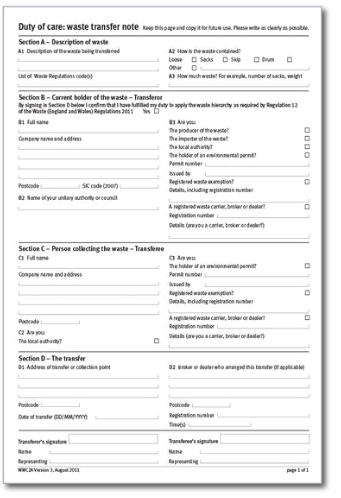
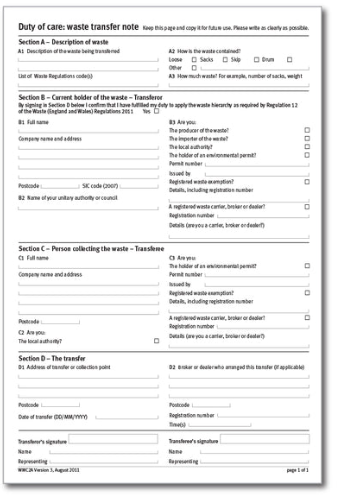
A waste transfer note, often referred to as a WTN, is a document used to record the transfer of non-hazardous controlled waste from one party to another.
For example, when a skip hire company collects waste from a construction site, the transfer must be covered by appropriate waste transfer documentation.
The document records information about the waste, the parties involved and the transfer itself.
Its purpose is to provide an accurate record of the waste being passed between the waste producer or holder and the person collecting or receiving it.
A waste transfer note is not a certificate confirming that waste has been recycled or finally disposed of.
When Do You Need a Waste Transfer Note?
Waste transfer documentation is generally required when non-hazardous controlled waste is transferred between different holders.
Common examples include:
- A skip hire company collecting waste from a building site.
- A contractor arranging collection of commercial waste.
- A business transferring waste to an authorised waste carrier.
- A waste carrier delivering waste to another authorised waste operator.
The documentation must be completed for the transfer and accurately describe the waste involved.
There are different arrangements for hazardous waste, which normally requires hazardous waste consignment documentation instead.
For official guidance, see GOV.UK's Dispose of Business or Commercial Waste guidance.
Who Is Responsible for Completing the Waste Transfer Note?
Both parties involved in a waste transfer have responsibilities.
The person transferring the waste must provide an accurate description of it, while the person receiving the waste must ensure that the relevant documentation is completed.
The waste description should reflect what is actually being collected.
For example, if a skip contains mixed construction waste, it should not be described as clean hardcore.
Providing inaccurate information can create problems with waste classification, transport and acceptance at the receiving facility.
Businesses should therefore confirm their waste types with their collection provider before the waste is removed.
What Information Must a Waste Transfer Note Include?
A waste transfer note must contain sufficient information to identify the waste and document the transfer.
The required information includes the following.
Description of the Waste
The waste must be described accurately.
This may include the type of material, its composition and other relevant characteristics.
Waste Classification Code
Waste must be identified using the appropriate List of Waste code, often referred to as an EWC code.
The correct code depends on the source and nature of the waste.
For example, different codes may apply to wood, metal, construction waste and mixed waste.
Quantity of Waste
The document should record the quantity being transferred.
This may be expressed by weight, volume or another appropriate measurement.
Details of the Parties Involved
The names and addresses of the parties transferring and receiving the waste must be recorded, together with the relevant authorisation details.
Date and Place of Transfer
The documentation must identify when and where the waste transfer takes place.
Required Declarations and Signatures
The appropriate declarations and signatures must be completed by the parties involved.
The waste hierarchy declaration must also be included where required.
What Is an EWC Code?
An EWC code is a classification code used to identify a particular type of waste.
These codes form part of the List of Waste classification system.
Different waste materials and sources have different codes.
For example, construction and demolition waste may include separate classifications for wood, metals, concrete and mixed materials.
Some waste entries are hazardous, while others are non-hazardous. Certain materials require assessment before the correct classification can be established.
The code must be selected based on the waste's actual composition and origin, rather than simply choosing a description that appears convenient.
For further information, refer to the Environment Agency's Waste Classification Technical Guidance (WM3).
Do You Need a New Waste Transfer Note for Every Skip Collection?
A waste transfer note can cover an individual transfer.
For repeated transfers of the same type of waste between the same parties, a season ticket may be used, provided the applicable conditions are met.
A season ticket can cover qualifying transfers for up to 12 months.
However, the waste description must remain accurate.
If the waste type or other relevant details change, the documentation may need to be updated or a new transfer note completed.
For example, a season ticket covering a particular non-hazardous waste stream should not simply be used for a substantially different waste type without checking that the description and classification remain correct.
How Long Must Waste Transfer Notes Be Kept?
Businesses must retain copies of their waste transfer notes for at least two years.
The records must be made available to the relevant regulator if requested.
Keeping waste documentation organised can also help businesses demonstrate how their waste has been managed.
For construction contractors and businesses arranging regular waste collections, maintaining a central record of waste transfer documentation can make compliance checks easier.
Is a Waste Transfer Note the Same as a Hazardous Waste Consignment Note?
No. They serve related purposes, but they are used for different categories of waste.
A waste transfer note is used for non-hazardous controlled waste.
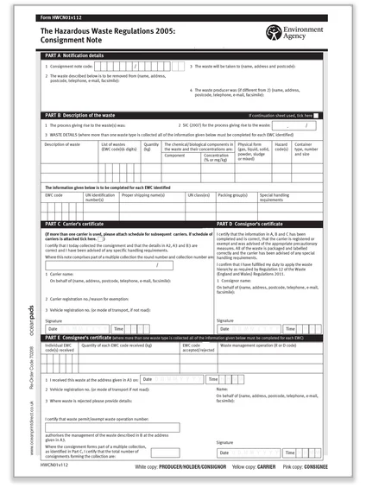
Hazardous waste normally requires a hazardous waste consignment note, which contains additional information and follows different requirements.
Asbestos waste, for example, must be managed using the appropriate hazardous waste documentation.
If your project involves asbestos-containing materials, our Complete Guide to Asbestos Skip Hire explains the collection and disposal process.
For further information about hazardous waste paperwork, see GOV.UK's Hazardous Waste Consignment Notes guidance.
Does a Waste Transfer Note Prove That Waste Has Been Recycled?
No.
A waste transfer note records the transfer of waste between parties.
It does not, by itself, establish the final recycling, recovery or disposal outcome.
Businesses requiring evidence of a particular treatment or disposal route should discuss their documentation requirements with their waste provider.
It is important not to confuse proof of collection with proof of final treatment.
What Happens if a Waste Transfer Note Is Incorrect?
Incorrect waste documentation can create compliance problems.
For example, an inaccurate waste description may mean that the receiving facility is not authorised or equipped to accept the material.
It can also affect the correct classification and handling of the waste.
If the waste differs from the description originally provided, the parties involved should establish the correct information and ensure the documentation reflects the actual waste.
Businesses should never knowingly provide an inaccurate description to obtain a cheaper disposal price or avoid additional waste requirements.
What Other Waste Responsibilities Do Businesses Have?
Completing a waste transfer note is only one part of the waste duty of care.
Businesses must also take reasonable steps to ensure that waste is managed correctly.
This includes preventing waste from escaping, checking that waste is transferred to an authorised person and providing an accurate description.
Separating different materials can make waste easier to identify and help prevent unsuitable materials from being mixed together.
Our guide, What Is Waste Segregation and Why Does It Matter?, explains how businesses can organise their waste streams more effectively.
You can also read the official Waste Duty of Care Code of Practice for further information about business responsibilities.
Waste Collection and Documentation with Smart Environmental
Smart Environmental provides RoRo skip hire for construction, commercial and agricultural projects across Nottinghamshire, Derbyshire and surrounding areas.
Our services include 20-yard and 40-yard RoRo skips for suitable waste streams, with collection arrangements based on the type and quantity of waste produced.
We also provide dedicated enclosed asbestos skips, with the appropriate hazardous waste consignment documentation for agreed asbestos waste collections.
When requesting a quotation, providing an accurate description of your waste helps us identify suitable collection and disposal arrangements.
Visit our RoRo Skip Hire page to learn more about our general waste collection services.
Need to Arrange a Waste Collection?
If you're planning a construction, demolition or commercial project, Smart Environmental can discuss your waste requirements and suitable skip hire arrangements.
Contact us with your project location, expected waste types and estimated quantities.
Call 01623 272 919 for a quotation.