
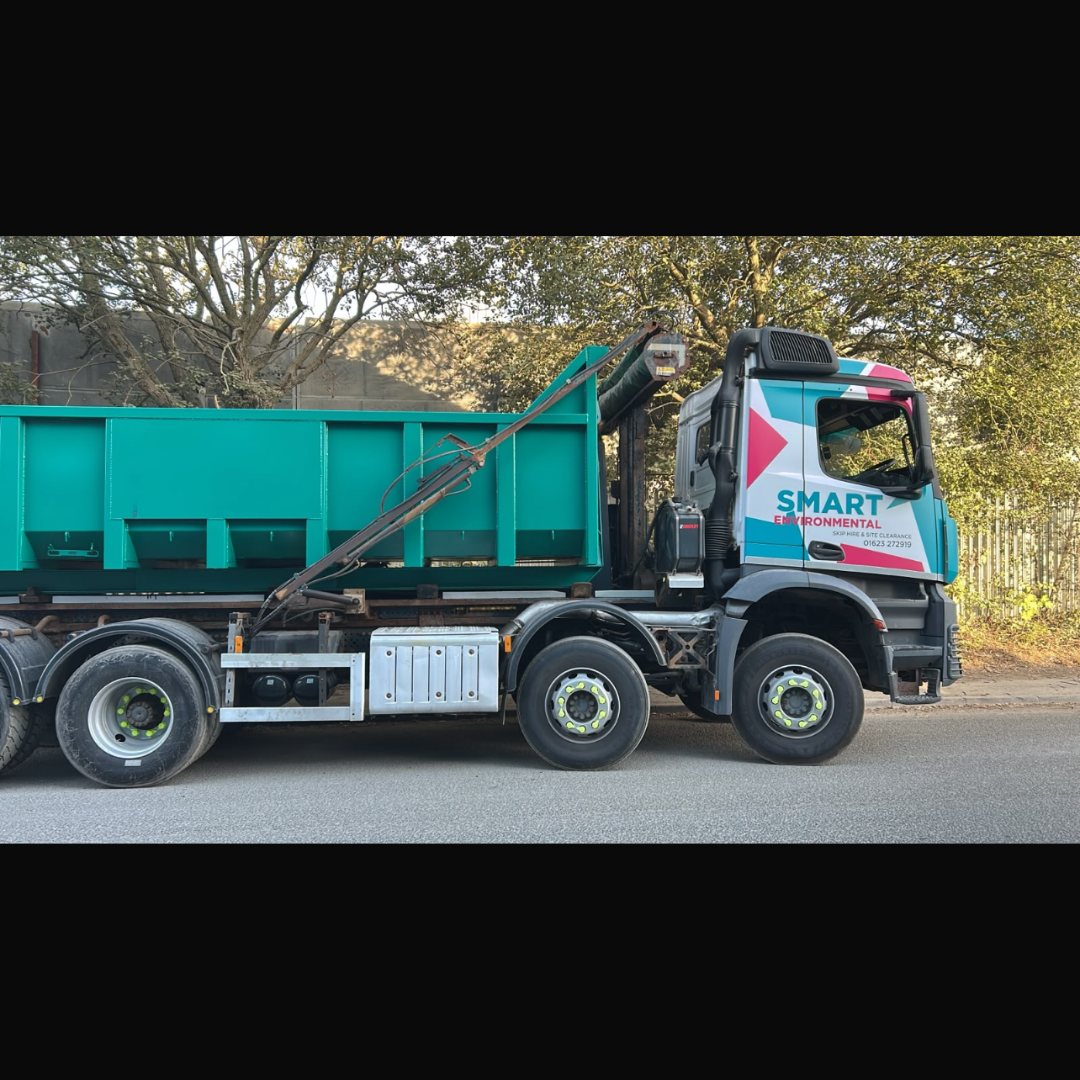
How Much Waste Fits in a RoRo Skip? Understanding Capacity, Volume and Weight
One of the most common questions when arranging a roll-on roll-off (RoRo) skip is how much waste it will actually hold.
The answer isn't always as straightforward as the size of the container suggests.
A skip might have plenty of space remaining but already be approaching its permitted weight limit. Equally, bulky lightweight waste can fill a container without creating an excessively heavy load.
Understanding the difference between volume and weight can help you estimate your requirements, avoid overloading and arrange collections at the right time.
At Smart Environmental, we provide 20 and 40-yard RoRo skip hire for projects across Nottinghamshire, Derbyshire and surrounding areas.
This guide explains how to estimate your waste quantities and make better use of your skip capacity.
What Does RoRo Skip Capacity Mean?
RoRo skip capacity is normally expressed in cubic yards.
This measurement describes the volume of space available inside the container.
For example:
20-yard RoRo skip: Approximately 20 cubic yards of capacity, equivalent to 15.3 cubic metres.
40-yard RoRo skip: Approximately 40 cubic yards of capacity, equivalent to 30.6 cubic metres.
A 40-yard skip therefore provides approximately twice the volume of a 20-yard skip.
However, this doesn't mean it can carry twice the weight.
The amount of waste you can safely load depends on the material, its density and the permitted loading limits.
For a detailed comparison of our containers, read 20 Yard vs 40 Yard RoRo Skips: Which Size Do You Need?
What's the Difference Between Waste Volume and Weight?
Volume measures how much space something occupies.
Weight measures how heavy it is.
These two measurements are related, but they are not interchangeable.
Imagine filling two identical containers.
The first contains loose timber and packaging. The second contains compacted soil or concrete.
Both containers might appear equally full, but their weights could be dramatically different.
This is why you cannot choose a skip based on volume alone.
Why Does This Matter?
A container can reach its permitted weight limit before it reaches its full volume.
This is particularly important when disposing of dense materials.
Conversely, lightweight waste may fill a container by volume long before weight becomes the limiting factor.
The usable capacity of a skip is determined by whichever limit is reached first: volume or permitted weight.
How Do You Estimate the Volume of Your Waste?
For straightforward projects, you can begin by estimating the space your waste will occupy.
Volume is commonly calculated in cubic metres.
For a rectangular pile or space, multiply its length by its width and its height.
Example: Estimating a Waste Pile
Imagine you have a pile of waste measuring approximately:
Length: 4 metres
Width: 2 metres
Height: 1 metre
The estimated volume is:
4 × 2 × 1 = 8 cubic metres
This gives you a starting point when discussing your skip requirements.
However, waste piles are rarely perfect rectangles, so the result is only an estimate.
The amount of space required can also change depending on how the material is loaded.
Why Can Loose Waste Take Up More Space?
Waste often occupies more space once it has been removed, broken up or placed loosely into a container.
For example, materials from a building clearance may have been neatly stacked or fitted into cupboards and storage areas.
Once removed and placed into a skip, gaps between the materials can increase the overall space they occupy.
Demolition materials can also behave differently once broken into irregular pieces.
This means the original dimensions of a structure or storage area won't always tell you exactly how much container space the resulting waste will require.
When estimating quantities, allow for the way the material will be loaded rather than assuming every part of the skip can be filled without gaps.
Can You Fill a RoRo Skip Completely?
You can load a RoRo skip up to its agreed safe loading level, provided the permitted weight is not exceeded.
You must not assume that every container can be filled to the top with every material.
For dense waste, the weight limit may be reached well before the container appears full.
For bulky waste, the container may reach its permitted loading level first.
Never Load Waste Above the Permitted Level
Waste projecting above the container can create hazards during collection and transport.
Materials may become unstable or fall from the container, particularly when the skip is being lifted or moved.
A skip that is overloaded or cannot be transported safely may need to be corrected before collection can take place.
Always follow the loading instructions provided for your hire.
Why Is the Weight Limit So Important?
RoRo skips are transported using specialist vehicles, which must operate within their permitted weight limits.
The weight of the vehicle, container and waste all contribute to the total load.
The permitted amount of waste therefore depends on the particular vehicle and container being used.
It isn't possible to give one reliable maximum waste weight for every 20-yard or 40-yard skip without knowing the equipment and collection arrangements.
Contact Smart Environmental for the agreed loading limit for your container.
This is especially important if your project involves heavy materials.
How Can You Avoid Overloading Your RoRo Skip?
Overloading is easier to prevent when waste quantities and collection arrangements are considered before the container is delivered.
Estimate Your Waste Before Booking
Try to establish the approximate quantity of waste your project will produce.
If you have plans, measurements or estimated quantities from a contractor, these can help.
Describe the Waste Accurately
Tell us what material you're disposing of.
A description such as "building waste" may not provide enough information if the load contains substantial quantities of dense material.
Follow the Agreed Loading Limits
Do not exceed the permitted waste weight or loading level.
A skip that looks half-empty may already contain a substantial weight of material.
Avoid Leaving Collection Until the Last Minute
If your project is generating waste quickly, arrange collection or exchange before the container becomes overloaded.
Keep the Load Stable
Distribute waste appropriately and avoid creating unstable piles or allowing materials to project beyond the container.
If you're unsure about a particular load, contact us before adding more waste.
Is It Better to Arrange a Skip Exchange?
For projects generating waste continuously, a planned skip exchange can help prevent delays.
Rather than waiting until the container is completely full, you can arrange for it to be collected and replaced at an agreed stage of the project.
This may be particularly useful for:
- Ongoing construction work.
- Demolition projects.
- Commercial clearances.
- Projects with limited waste storage space.
The appropriate collection frequency depends on how quickly waste is produced and how much the container can safely hold.
Consider the Different Stages of Your Project
Waste quantities often change as work progresses.
An initial clearance may generate substantial amounts of waste in a short period, while later stages produce smaller quantities.
Planning collections around these stages can help keep the site organised without leaving waste accumulating unnecessarily.
How Do You Know When Your Skip Is Ready for Collection?
A skip doesn't always need to be completely full before collection is arranged.
It may be ready when:
- It has reached its agreed safe loading level.
- It is approaching its permitted weight limit.
- The relevant stage of the project has finished.
- You need the space for other site activities.
- The waste needs to be removed before the next phase of work.
For ongoing projects, planned collections can be more convenient than waiting until the container is full.
Contact us to discuss collection or exchange arrangements.
Does a Larger Skip Always Mean Fewer Collections?
Not necessarily.
A larger container offers more volume, but its suitability depends on the waste being loaded.
For substantial quantities of suitable lightweight waste, a 40-yard RoRo skip may reduce the number of collections required.
For heavy materials, a larger container is not the solution.
Our 40-yard RoRo skips must not be used for soil, hardcore, rubble or concrete.
Suitable heavy waste requires an appropriate container and agreed loading limits.
If you're unsure which materials can be accepted, read What Can You Put in a RoRo Skip?
What Information Should You Have Before Requesting a Quote?
You don't need to calculate the exact weight of every piece of waste before contacting us.
However, a few basic details will help us discuss your requirements.
Type of project
Is it a demolition job, building project, commercial clearance or another type of work?
Waste description
What materials will you be disposing of?
Estimated quantity
Do you have an approximate volume, measured pile or quantity from your contractor?
Project duration
Will the waste be produced over a few days or several weeks?
Collection requirements
Will you need one collection or regular skip exchanges?
Providing this information helps us identify a suitable arrangement and prepare a quotation based on your actual requirements.
Need Help Estimating Your RoRo Skip Requirements?
You don't have to work everything out on your own.
If you can tell us what you're disposing of, approximately how much waste you're expecting and how your project will operate, we can discuss an appropriate container and collection arrangement.
Smart Environmental provides RoRo Skip Hire across Nottinghamshire, Derbyshire and surrounding areas, including Nottingham, Mansfield, Derby, Chesterfield and Newark.
Whether you need a single container for a clearance or ongoing collections for a construction project, we're happy to discuss your requirements.
Call 01623 272 919 for a quotation.